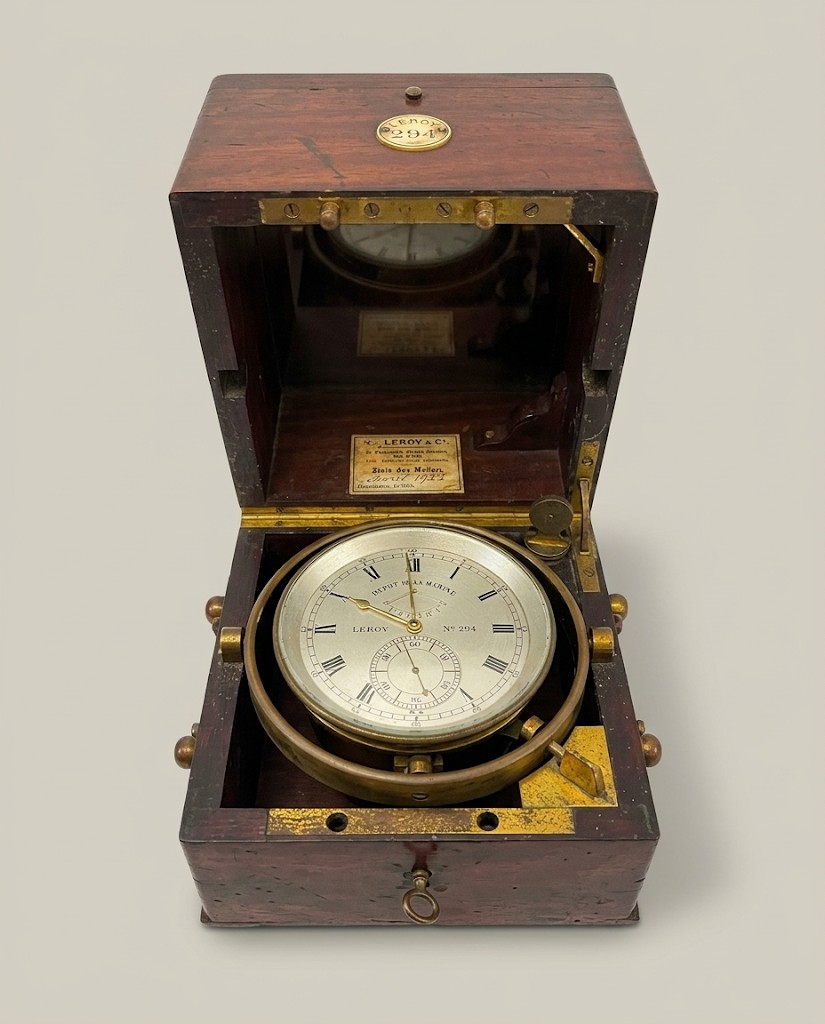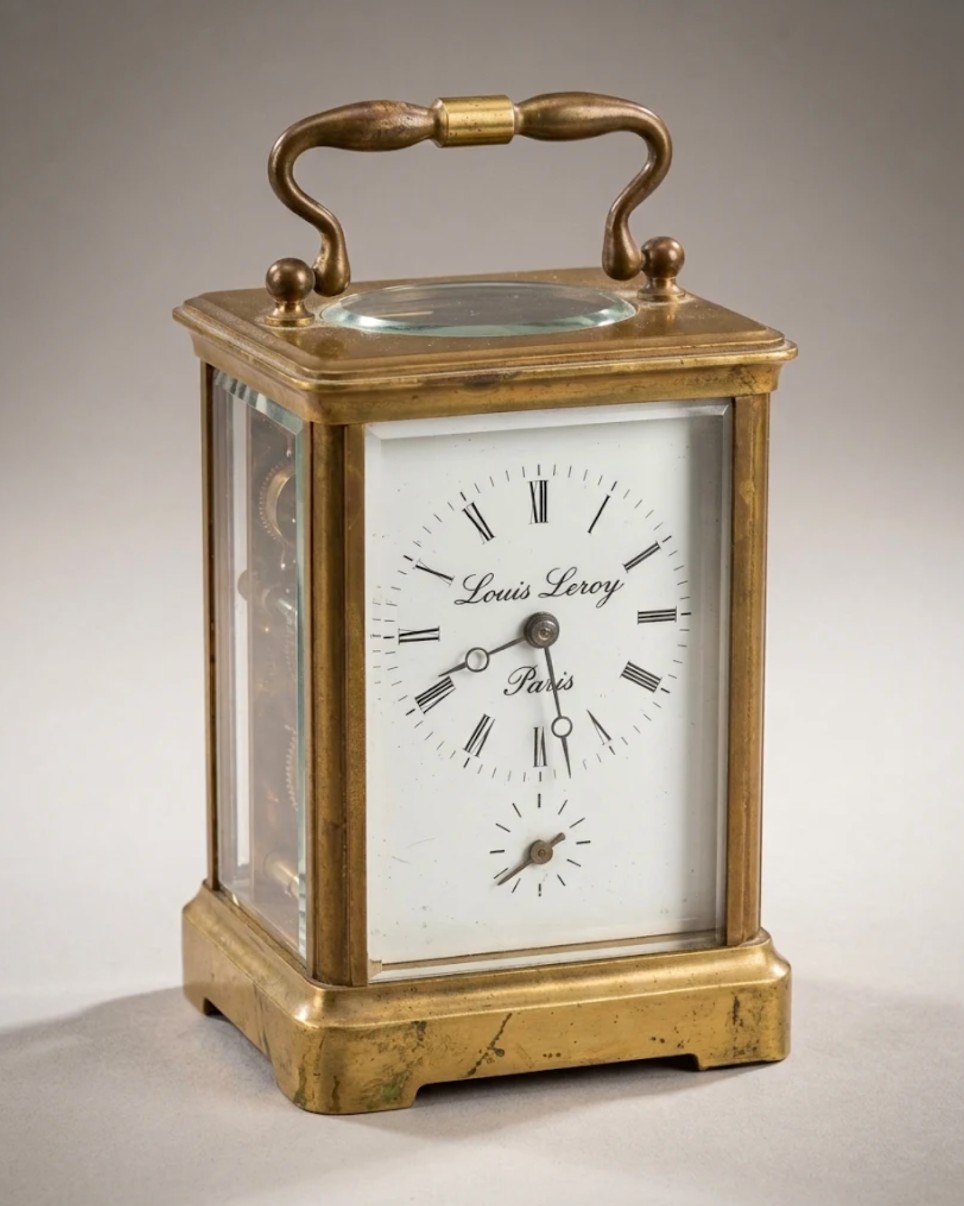
Photographs of the piece; the described condition prevails.
Officer's Alarm Clock, L. Leroy
Bronze and brass, signed enamel dial, Paris
420 €
Prices include all taxes (VAT not applicable, art. 293 B CGI)
- Checked by the House before shipping
- Secure card payment
- Insured, tracked delivery
- 14-day returns
- Period
- Late 19th or early 20th century (estimated); 1880 according to the seller
- Dimensions
- H. 12 cm, W. 8.5 cm, D. 7 cm1,23 kg
- Material
- Brass and bronze, five bevelled glasses, white enamel dial
- Marks
- Dial signed 'Louis Leroy, Paris'; movement No. 280 stated, to be read on the piece
- Provenance
- Belonged to an officer according to the seller, undocumented
- Condition
- Good3/5 · Auction-house scaleStated as running; alarm needs service; wear to the base; with its keys
- Location
- French Riviera, Francethe piece is within a 200 km radius
Note prepared by the House, confirmed on the piece before any sale
Value and 10-year trend
- Category: Antique clocks and instruments +3.3 %/yr
- Rarity○○○
- Signature●●
- Documentation○○
- Condition 3/5
- Market taste stable
Trend applied: 4.32% a year, range ± 4.0 points.
The House's estimate, drawn from real public sales and published indices. A trend, not a promise. How we work it out
Aurèle's note
Leroy supplied officers, travellers and the courts of Europe. The L. Leroy signature points to the firm as taken over by Louis Leroy at the end of the 19th century: the seller's date of 1880 is probably a little early, and we would rather say so. The movement runs; the alarm needs a service.
Aurèle Saint-Clair
The story
Paris, 1796. Abraham-Louis Breguet builds what the Louvre regards as the first modern travel clock: small, glazed on all four sides, designed to follow its owner along the roads. It is said that Bonaparte, before leaving for Egypt, asked Breguet for one, and that the orders placed with clockmakers then read 'a clock for an officer'. The name stuck: the officer's clock.
At the same time, under the arcades of the Palais-Royal, another house already counts the Empire among its clients. Founded in 1785 by Basile-Charles Le Roy, it keeps time for Napoleon, his sister Pauline and Madame Mère; in 1835 the Navy appoints it as its watchmaker. In 1889 Louis Leroy takes over and the house becomes L. Leroy & Cie. The century, meanwhile, turns the travel clock into an industry: at Saint-Nicolas-d'Aliermont, in Normandy, Armand Couaillet's workshop alone produces thousands between 1880 and 1920.
This one bears on its white enamel dial, among the Roman numerals, the signature 'Louis Leroy' and the word 'Paris', with the small dial of its alarm below. Its brass case, 12 cm high and weighing 1.23 kg, opens onto the world through five bevelled glasses, including a window on top through which the escapement can be seen at work; the handle lifts for travelling. According to its seller it truly belonged to an officer, which we cannot document, and it runs for about ten days on a single winding; the alarm needs a service, and its keys come with it. The seller dates it to 1880; Louis Leroy's signature more likely places it after 1889, and we would rather say so.
What we know
- Enamel dial signed L. Leroy, Roman numerals
- Five bevelled glasses, runs over a week, alarm needs service
- H. 12 cm, 1.23 kg, with its keys
Delivery and returns
Every piece is checked, hand-packed and sent insured and tracked. Shipping costs are shown before any payment. You have 14 days after receipt to return it.
Watches